
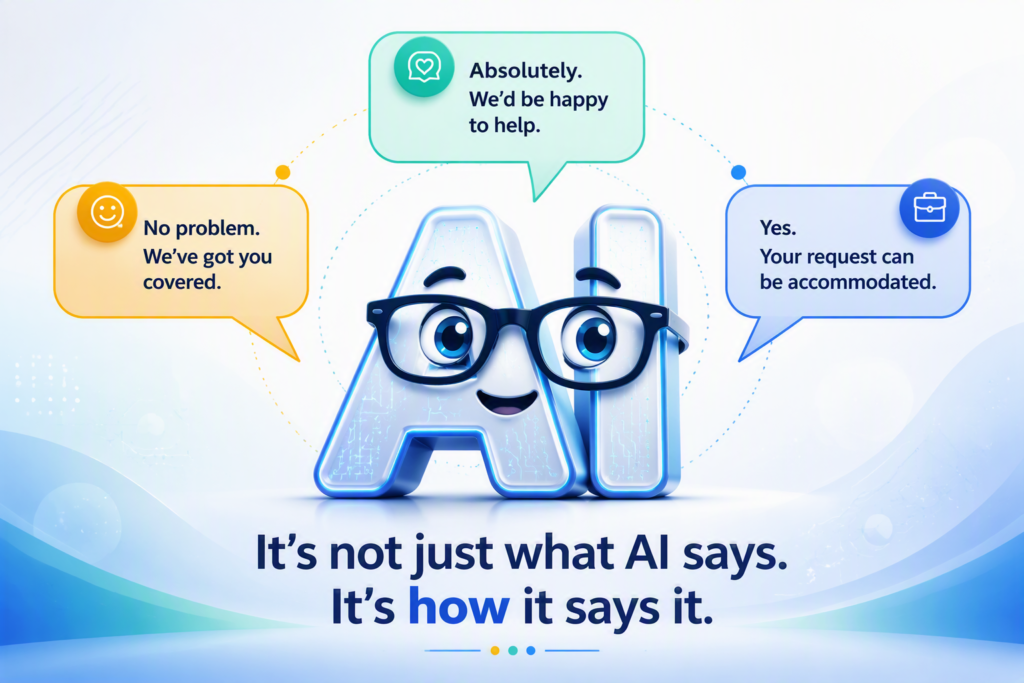
AI is getting very good at giving the right answer.
And that could be a problem.
Organisations are investing heavily in AI‑powered personalisation. AI can analyse customer data, understand context, recognise patterns and draw on previous interactions to produce increasingly relevant responses. The promise is compelling: make every interaction more relevant, more efficient and more personal.
But perhaps there is a question we are not asking.
What happens when everyone can do it?
As AI capabilities become more accessible, personalisation may stop being a differentiator. Customers will expect organisations to know who they are, understand their needs and respond appropriately. What feels impressive today may simply become the standard tomorrow.
So, the challenge may no longer be whether AI can give the right answer. It may be whether it can give the answer in a way that feels like you.
Take a simple example.
A customer asks, “Can I change my booking?”
The policy allows bookings to be changed up to 48 hours before the scheduled date.
One organisation might respond:
“Yes. Bookings can be amended up to 48 hours before the scheduled start date”.
Another might say:
“Absolutely. We know plans can change. Just let us know at least 48 hours beforehand and we will be happy to help.”
Or:
“No problem. Need to switch things around? You can update your booking any time up to 48 hours before the event starts.”
The policy has not changed. The information has not changed. The answer is essentially the same – But the experience is not.
One feels functional. One feels reassuring. One feels relaxed and conversational. And that difference matters because communication has always been part of how organisations distinguish themselves.
We invest in brands, values, tone of voice, customer service and training because we understand that customers do not simply experience what an organisation does. They experience how it communicates. Yet when we talk about AI, the conversation often becomes much more technical – Data. Models. Knowledge. Automation. Accuracy. Compliance – All important. But increasingly, AI is not just processing information on behalf of an organisation – It is speaking for it.
That changes the question – A family‑owned business may want to sound warm, personal and approachable. A professional services organisation may want to communicate with authority and confidence. A consumer brand may deliberately choose to be informal and conversational.
The information they provide could be identical – How they communicate it should not be.
There is a complication.
Making AI sound more human will not necessarily make the experience better. An AI that becomes overly familiar, uses forced empathy or tries too hard to sound like a person can feel uncomfortable. What is intended to be warm can come across as artificial. What is intended to be empathetic can feel intrusive. When a machine starts talking as though it understands how we feel, the result can be less reassuring, not more.
So perhaps the goal is not to make AI more human – Perhaps it is to make it sound right.
Sometimes that means empathy. Sometimes clarity. Sometimes brevity. Sometimes simply giving someone the information they need without trying to manufacture a relationship that is not there. Knowing the difference requires judgement. And that is where I think the next AI challenge lies.
We have spent the first phase of AI adoption teaching systems what to say. We have given them access to our information, processes, policies and customer data.
We have spent the first phase of AI adoption teaching systems what to say.
We have given them access to our information, processes, policies and customer data. The harder task is understanding how we should say it. Not just our tone of voice, but our values, our personality and our approach to customers. Knowing when to be warm and when not to be. When to reassure and when to be direct. When to personalise and when personalisation becomes intrusive. Not just our tone of voice, but our values, our personality and our approach to customers.
The harder task is understanding how we should say it.
Knowing when to be warm and when not to be. When to reassure and when to be direct. When to personalise and when personalisation becomes intrusive.
These are not simply technical decisions. They are decisions about the kind of experience an organisation wants to create.
And that may become increasingly important as the technology itself becomes less distinctive.
If everyone has access to powerful AI, having AI will not tell customers very much about an organisation.
Increasingly, I believe the challenge will be teaching them how to say it.
Because in a world where almost everyone can deliver the right answer, the organisations that stand out may well be those that deliver it in the right way.